Lucreis' Guide to Lead Command
From November of 2025 through July of 2026 I was a player in Eparchia, a game of Cataphract run by the indomitable Square Allworthy. I began as the leader of the smallest of five starting factions: Lucreis Sempronia, Duchess of Velatia. By the end, I had accomplished all my objectives and jointly ruled a kingdom that covered more than half the map, with the rest held by my allies (though admittedly said allies were on the brink of war with each other). During that time I did a lot of thinking about optimal play for a faction leader and how it differs from being a subcommander, and with the game done I decided to share my brilliant insights (doubtless responsible for my glorious victory) with the rest of the Cataphract community.
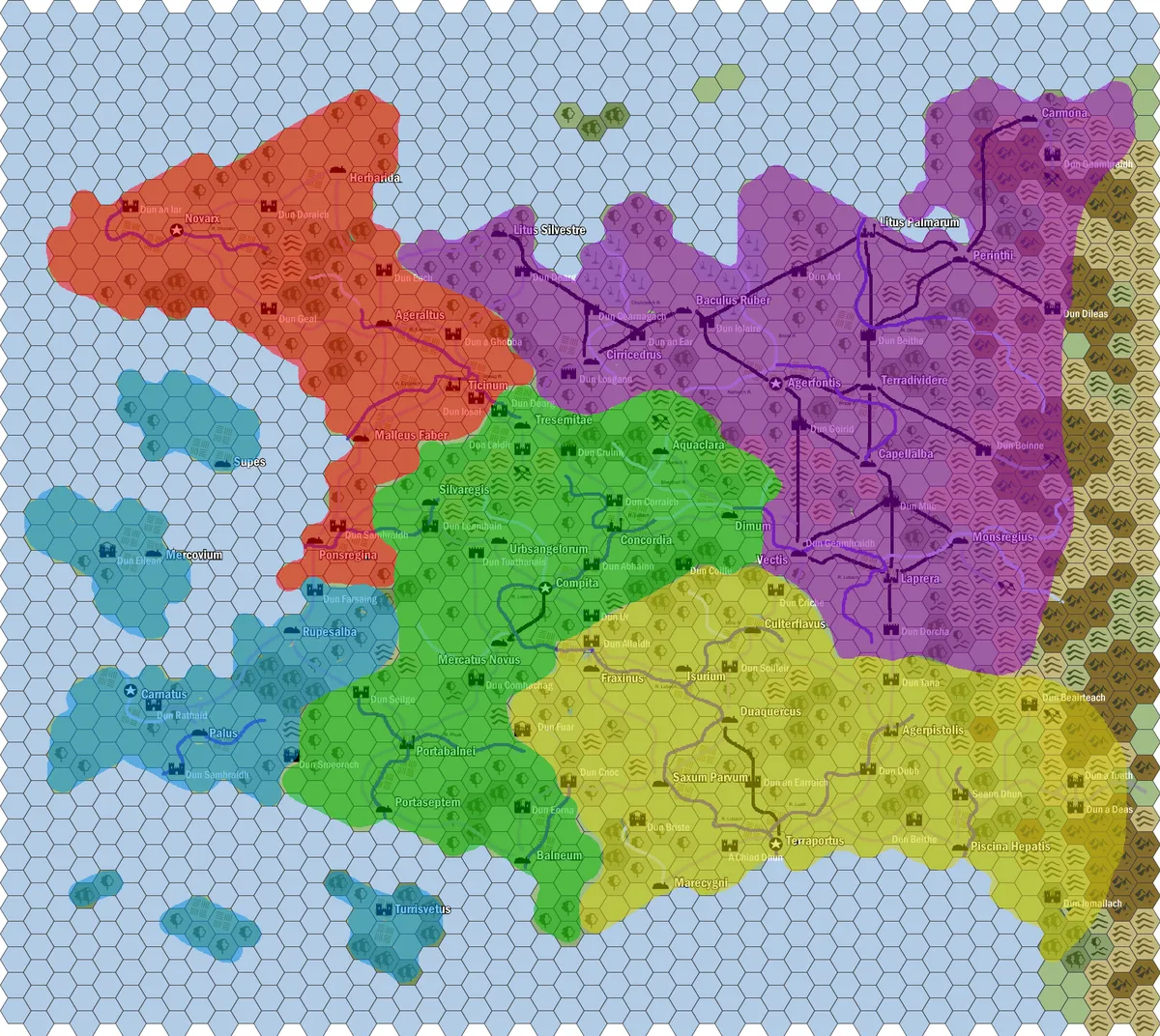 Eparchia at game start, with the Duchy of Velatia in blue.
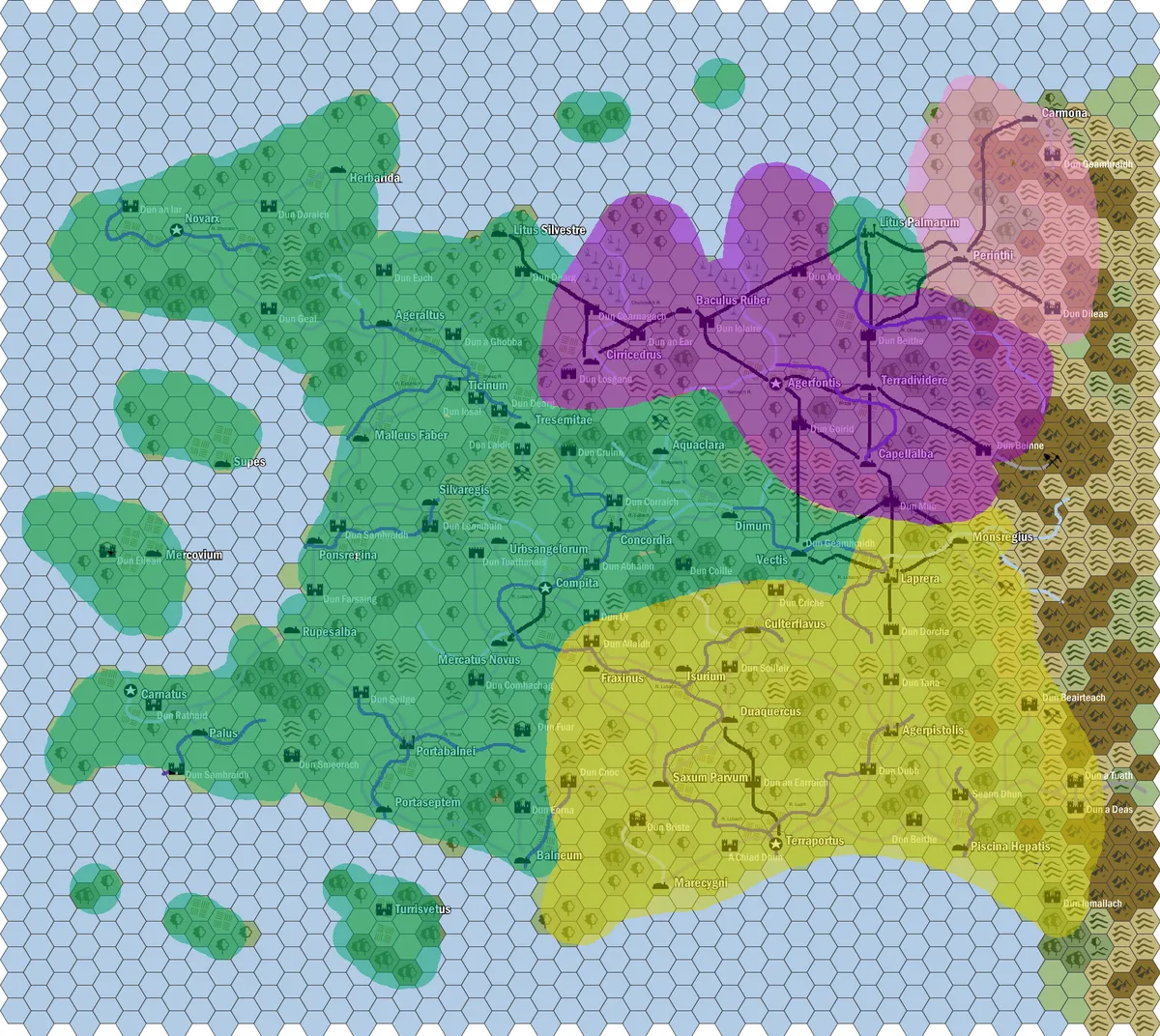 Eparchia at game end, with the High Kingdom of Veladdria in teal.
First, some disclaimers. While I have technically been a player in five games of Cataphract, I only led a faction in one game besides Eparchia, which ended prematurely due to ref burnout. Therefore my advice is mostly based on an N of 1, and may not apply to games with rules and initial setups different from Eparchia’s. In particular, this guide is written with the assumption that your faction is large enough to have 3 or 4 subcommanders and multiple theaters of operation. In a smaller game the role of faction leader is closer to that of a typical commander, and while parts of my advice may still be helpful my overall philosophy of being a leadcomm will not fully apply. Also, this guide is about how to win (by accomplishing the objectives provided by your ref), not how to have fun or how to play a character with verisimilitude. For me in Eparchia, the style of play I describe below wasn’t in significant conflict with the latter two goals, but for you it might be. In particular, many settings have diegetic concepts of good leadership which do not align with some of my recommendations, and in those cases I encourage you to play your character as losing respect for those who lead as I advise.
If you’d like to learn about the events of Eparchia before reading my reflections on them, you can check out the server here. It has a wealth of information now that all channels have been opened, though it may be difficult to sort through. High-level info about the setting and factions can be found in the Eparchia Information category, my primary channel during the game was #duchess-lucreis-of-velatia, and Square is writing a detailed account of the campaign in #a-brief-history-of-the-recent-wars, though as of posting it only covers the initial weeks.
With all that said, on to the hot takes:
You are not a general.
As we all know, Cataphract is a game about the operational level of warfare, in which you command an army. Right? Wrong. As a faction leader you command a kingdom, or a horde, or perhaps a revolutionary front (there might technically be an NPC leader above you, but you can't rely on them). Generally, you should not be thinking about the details of operations (in the military theory sense, not the things you spend loot on). You do need to consider operational constraints (how long will it take to redeploy this army? is there enough supply available in this region to support a large concentration of force?) but when individual armies forage and the particular routes they take as they move are mostly not your concern. As a corollary: with a few exceptions, you should not directly command an army. Why?
You are valuable. A faction whose leader has been captured is fighting with a severe handicap. Diplomatic messages sent to you by other factions are lost; subcommanders stop and wait for orders that won’t come, or go looking for you and walk into the superior army that captured you. Ideally you have a designated successor who quickly realizes you have been captured and organizes the rest of the faction while trying to arrange your freedom, but even in this case much momentum will be lost. How to avoid this? Don’t fight battles, and don’t command an army which might be forced into a battle. Sometimes, particularly around sieges, you may be with a combat army of your faction and help to plan its tactics, but you should still let your subcommander of that army be the one to actually lead troops into battle.
Leading an army imposes movement constraints that make your real job more difficult. For reasons I’ll get into more later, it’s usually best as a faction leader to alternate between periods of very fast movement and periods of being stationary. Leading an army in the typical case (moving at infantry speed into enemy territory or to deal with an invader) is the worst of both worlds: your position is uncertain from the perspective of your distant subcommanders, but you can’t run off at high speed if you really need to be somewhere. You will be more effective if you can choose your location on the map based solely on where it’s most valuable for you personally to be, not where the army you’re commanding has to go.
(When is it reasonable for a faction leader to command an army? Depending on the rules, when moving overland it may be worthwhile to have a small cavalry escort that you ride around with at a forced march. During stationary periods you may end up in command of garrisons or troops that are resting, but this should be considered a temporary arrangement. Also, if you don't trust some of your subcommanders but can't act against them yet you might need to maintain an army which is only loyal to you.)
So, if you aren’t commanding an army and planning its operations, what are you doing? I think the leader of a Cataphract faction has three primary roles: you are a strategist, you are a diplomat, and you are a router of information. Let’s take them one at a time.
Strategy
This one is arguably the most important, but I don’t have much to say about it at a high level, because it’s the least specific to Cataphract. As leader, it’s your job to decide which wars to fight and how to distribute the forces at your disposal between them. The relevant principles here are shared with many other strategy games: figure out which fights are essential to accomplishing your objectives, if possible fight those fights as part of a coalition stronger than the enemy one, and direct your forces so as to always achieve local numerical superiority in the active theater. If you want more tips, read Clausewitz or something.
There is one sort-of-strategic matter which I will expand on a bit more: at the beginning of a campaign, how should you distribute your detachments among your commanders? This will obviously depend on your commanders themselves and the specific challenges facing you, but it’s useful to consider the kinds of armies you’ll want to form. I propose a fourfold typology, corresponding to the four fundamental tasks an army in Cataphract can perform: taking strongholds, defending strongholds, gathering information, and moving supplies. Most armies should be specialized for one of these tasks.
(Note that these descriptions assume a ruleset like Sorensen 1.2 or DPR 1.1 where it’s pretty easy to take strongholds with default garrisons by assault. In future rulesets designed to encourage sieges the first two types will be somewhat different.)
- Assault armies. Typically infantry-based, these armies have the effective strength necessary to assault default garrisons with the best possible chance of success, plus some margin so they can maintain this capability after taking casualties. With wagons, this type of army is also often around 6 miles in length, making it a natural size. These are your core striking forces. A sizable faction should aim to field at least one of them, and ideally multiple. When battle with enemy assault armies is expected, they should try to combine their strength.
- Garrison armies. The purpose of these armies is to force attackers to lay siege to the stronghold they’re defending instead of taking it by assault. Therefore they should be large enough to have good odds against an assault army when factoring in stronghold defensive bonuses, but otherwise have the minimum possible supply consumption (so don’t use cavalry). Strongholds which you think might be attacked but won’t have a friendly assault army nearby should usually get at least a small garrison army. In most cases these don’t require player commanders. However, if you’re leaving a headless garrison, make sure it has plenty of supplies stockpiled.
- Reconnaissance armies. These armies are the operational or strategic counterpart of the tactical scouts possessed by every army. Their job is to locate and track enemy (and sometimes allied) forces, while using their superior mobility to avoid battle (except against other reconnaissance armies and easy targets like some logistics armies). Therefore they should usually be made of cavalry (or sometimes skirmishers) and be quite small: one detachment is generally sufficient.
- Logistics armies. The domain of the vaunted wagon-lord. These armies serve to acquire supplies and move them to where they will be eaten. As a faction leader, you mostly shouldn’t be thinking about these, as they will be subordinate to other armies; a typical case is for the commander of an assault army conducting a siege to split off their wagons plus a skirmisher detachment to go forage somewhere else. One notable exception is if you have lots of ships with good water access to relevant theaters. In this case, moving large quantities of supplies across long distances becomes viable and the fleet or convoys doing it rises to strategic significance.
When initially organizing your forces, most armies should fall into one of these categories and be constituted with the above guidelines in mind. Other sizes and compositions should require a specific goal, like defeating a particular kind of enemy army that you expect to be in a particular place. As campaigns progress and casualties mount, these categories will of course get much blurrier, but they are generally a good starting point.
Diplomacy
Diplomacy is perhaps the most powerful lever you have for directly influencing the course of the game. You can plan the strategy your armies will try to execute and do your best to coordinate their movements from afar, but ultimately their performance in the field is in the hands of your subcommanders. Where your personal efforts can dictate success and failure is in conversation and negotiation with other factions. Besides any unique diplomatic objectives you may have, these activities have two overlapping aims: avoiding war with anyone you don’t need to fight in order to accomplish your objectives, and gaining allies which will fight beside you in those wars which are necessary. In service of these goals you should quickly make contact with other factions, try to suss out their goals and plans (often by sharing some of your own) and if possible work towards one or more enduring alliances.
You may reasonably ask: why not delegate this task, as with the command of armies? After all, some games even have a distinct player role for diplomats. It can sometimes be useful to send a subordinate to conduct negotiations in your stead, but this has a number of drawbacks which do not apply to field command. Most centrally: you are the person with the best understanding of your faction’s goals and long-term plans, and ideally of the situation it finds itself in at any given moment. You will be receiving the reports from your subcommanders and the entreaties from other factions. This combination of information is essential to developing the ideal stance in negotiations. If you delegate major talks to a separate diplomat, you must choose between two difficult options: introduce significant friction and delay by requiring your envoy to confirm agreements with you by message, or give them the power to make binding deals on your behalf and run the risk that they will commit you to arrangements which are not beneficial in light of information you have. If you take the second route, you also reduce the trust that other factions will have in their agreements with your faction, as from their perspective there is always the possibility that you will be dissatisfied with the deal reached by your diplomat and seek to escape it. For these reasons, it is best to conduct major negotiations personally.
So, how do you do diplomacy effectively? First, unless you have a very good reason not to, be truthful and communicative. This does not mean “be open”; strategically withholding information is often useful. But you do want to create the appearance of openness by sharing some information, and to build trust you want to make sure that information is true. Successfully lying in Cataphract is hard, because it’s very difficult to know what information your interlocutor has (or might gain in the future) which could contradict your claims. Even when you’re trying to deceive someone, it’s usually better to do it with selective true statements. This minimizes your chance of being caught and helps to play it off as a misunderstanding if you are. When you aren’t specifically manipulating someone, you should be building a reputation as a helpful and trustworthy character. Write to other leaders regularly, even if you don’t have specific negotiations to conduct. Pass along news (ideally about other factions’ activities, though it’s fine to share some of yours if the information can’t be used against you). Partly this reassures people that you don’t mean them harm, partly it elicits information from them, partly it establishes you as a trusted source. Once you have built up the the right knowledge and reputation and relationships, achieving a particular alliance will be much easier.
(I would be remiss not to mention here that I have seen aggressive outright lying work well in Cataphract. Eparchia had a commander named Órlaith Greenrider who conducted a remarkably effective campaign of deception that included such galaxy-brain plays as forging a letter from me to her and then sending me a reply to it, causing me to believe until the end of the game that someone else had tricked her with the forgery. I still think this kind of strategy is very risky, but it can be indicated in certain situations, particularly if other factions don’t know very much about you or your objectives are about taking certain difficult-to-reverse actions [like killing someone or bringing a quantity of loot off-map] rather than maintaining a certain state of affairs [like territorial control] into the long term.)
So, you’ve reached the negotiating table, and have to convince a stronger enemy not to completely destroy you, or put together a coalition against your next target, or pressure one of your allies into backing down from their dispute with another. What now? This is another big topic that extends beyond Cataphract, and much has been written about how to conduct negotiations by people more experienced than I. Therefore I will again confine myself to one particular subtopic, which I thought about a lot while mired in some dense parley threads. I find it is very common for negotiations in Cataphract to end up in what I will call the debate frame. In the debate frame, each side presents arguments for why the outcome they want is justified in some objective sense (usually appealing to diegetic custom or morality) with the apparent goal of convincing the other to abandong their position and accept this “correct” outcome. This can lead to long and often circular arguments.
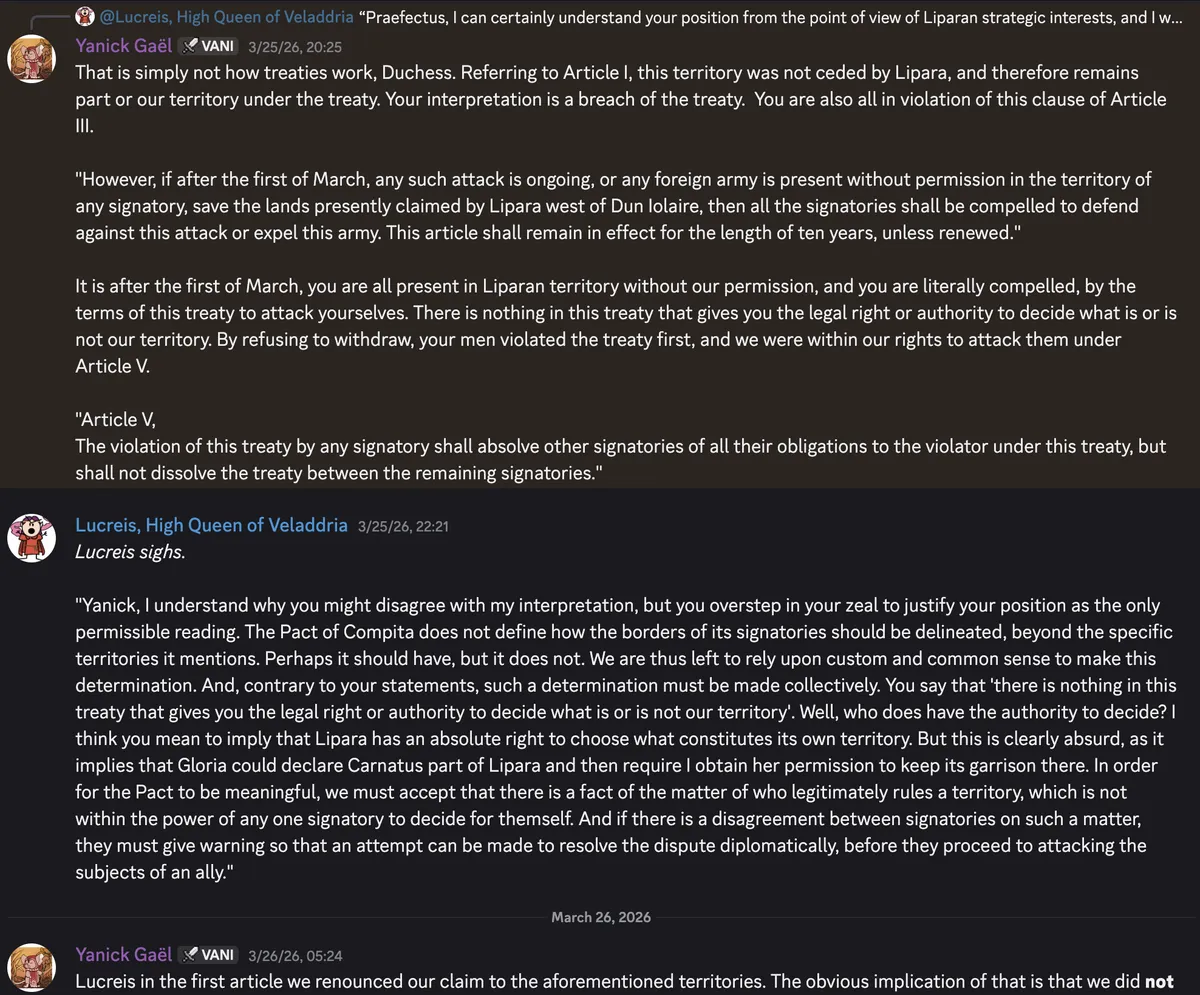 "Is Trutina Part Of Lipara" - the greatest thread in the history of Eparchia, locked by a moderator after 12,239 pages of heated debate,
I want to be clear: I am not saying you should try to avoid the debate frame. It can be fun, frequently makes diegetic sense, and if you are good at it you can come away with concessions that couldn’t be achieved with other approaches. However, it is useful to keep in mind other ways of understanding a negotiation. In particular, the following model: going into the negotiation, each side has basically fixed goals and a BATNA (best alternative to negotiated agreement). This is the action they will take (and its likely outcomes) if no agreement can be reached with the other parties. In Cataphract, this often means commencing or resuming war with those parties. Each participant is trying to determine what agreements exist such that for each participant, the agreement is better for them than their BATNA. Ideally they have each already thought about possible agreements and how they compare to their BATNA. The meat of the negotiation, then, is trying to determine how the surplus of benefit above the various BATNAs is divided between the parties (which may involve trying to deceive other parties about what benefits you and what your BATNA is). The parties consider each other’s true goals to be fixed, and don’t try to to convince each other to change them; arguments about the “correct” outcome are only relevant insofar as they influence how outside players might respond to certain outcomes (such as one party taking their BATNA of going back to fighting). If you find a negotiation is dragging on into a tangential debate, or that you’re being talked into accepting something worse than you could have gotten by not negotiating at all, try thinking of it in these terms.
Once you have come to some agreement, there is the matter of ensuring it endures. This is difficult but often very worthwhile. A coalition whose members do not expect it to last through the game is substantially weaker than one where they do, even while it lasts. Its members will withhold knowledge of their true capabilities from one another; they will try to arrange for each other to take the brunt of the fighting. As the coalition’s goal comes within reach, they will increasingly devote their efforts to preparing to fight each other. Even if no one involves wants the alliance to collapse, the limited information of Cataphract is the perfect habitat for paranoia, and it is easy to become convinced that you will be betrayed and must act first. Sometimes you will have to make agreements you expect will be broken later on, but when possible you should invest in permanent ones. So, how to make an agreement last? Essentially, you want to make breaking it more costly. Usually this means imposing reputational costs: ensuring that if anyone breaks the agreement, they will be a pariah to as much of the world as you can manage. To this end, write down the terms of your agreement and share them with as many people as you can (this also helps with resolving disputes later). Swear oaths. Establish what happens to oathbreakers in the afterlife. Exchange hostages, implicit or otherwise. Get married. Seriously, there’s a reason marriage alliances were popular historically. It’s a great commitment mechanism. For a truly stable alliance, you want all parties to be so bound up with each other that any serious betrayal means the whole thing goes down in flames for everyone, and they all know it.
Routing
In a perfect world, every commander would send a message to every other commander in their faction every day, containing their location, the date, and a report of what they saw that day. Each commander would thus maintain an independent mental map of the whole campaign, providing the most comprehensive and up-to-date possible context for their decisions. In the real world, your subcommanders will not do this. Even if they did, the referee would drop a meteor on you (unless you’re in Vanitera or some future Fully Automated Luxury Gay Space Cataphract). So, what’s the next best thing? Pick one person to receive reports, maintain a mental model of the campaign, and send key pieces of information from that model back down to the commanders at the front. As faction leader, you are that person.
Each of the subcommanders who report to you at a given time (which will not always correspond to the ones you personally recruited) should ideally send you a message every few days when they are moving, or more frequently when major events happen. Maintaining this frequency is important because losing mutual knowledge of your locations can lead to disastrous breakdowns in communication, and if you don’t correspond often then one missed message can leave you unsure where to send the next one. You should also make a point of how vital it is to date all messages. When you’re trying to reconstruct complex events happening days of messenger-time away, knowing the order of the reports you receive is extremely important. Also, this is already much discussed, but I will add my voice to the chorus: message encryption is almost never worth it. Interception is rare, and maintaining internal communication is hard enough without adding extra steps.
As you receive reports from your commanders (and public news, and information from people you talk to directly), you must assemble them into a continuously-updated guess at what the heck is going on out there. You may find it helpful to maintain your own shadow of the referee’s map, with markers for armies that you move around to represent your best guesses of their position. I instead tried to keep everything in my head, which worked reasonably well but did result in forgetting things occasionally. I would also sometimes make a calendar of when I expected certain events to take place based on movement speeds: A’s army should reach X on the 8th, I should get a reply to my last message to B on the 12th, etc. This is helpful for remembering when you should follow up on e.g. a message you were expecting that may have been lost.
With your model of the world in mind, you have to give orders and other information to your commanders. Here, you have a difficult balance to strike: on the one hand, you need to use your bird’s eye view of what’s going on to ensure your subordinates take the actions that best serve the whole effort; on the other, your information on the conditions they face is often incomplete and out of date and your orders may be hopelessly unsuited to them by the time they arrive. Here are some tips on how to navigate that.
- Provide clear objectives. Ideally your subcommanders will make many decisions for themselves, and to do this well they need to know what you want them to accomplish. You should usually give them objectives like “take and hold this region”, “find and destroy that army” or “figure out what’s going on there and then return here” that will take around 1-4 weeks to complete.
- Give context. Provide your subcommanders with information from a somewhat wider scope than what seems relevant to their immediate task, because it’s hard for you to know when a decision they’re making hinges on something happening elsewhere. Tell them where other subcommanders and allies are, so they can coordinate without routing through you if necessary. Note that you can go overboard with this: some players won’t pay full attention if your messages are too long. You can sometimes judge this by how long their own messages are.
- Delegate. If you have 10 subcommanders in your faction, they shouldn’t all report to you. Many of them should be primarily under the authority of another commander running their theater, and you should only message them directly when you have a very urgent change in orders to convey. Often this takes the form of a commander leading an assault army managing the subcommanders of a reconnaissance army and logistics army. Note that it can be useful to instruct scout commanders to send copies of their reports to you, even if they are primarily in communication with their immediate superior.
- Use conditionals (sparingly). If there are two clear possibilities for what might be going on where your subcommander is, give guidance for both cases. However, be wary of long, nested conditional orders, as they may result in parts of your message being forgotten. Sometimes it can be useful to structure orders like “My best guess is that your situation is X. If that's accurate, do Y. Otherwise, modify Y to fit what’s actually going on, keeping in mind that your primary goal is Z.”
- Encourage flexibility. If you give very specific orders via message (“forage, then march to this stronghold and assault it”) make sure your commanders are aware that these orders include an implicit “if that makes sense given any aspects of your situation I might not know about”. Sometimes your commanders will disregard your orders because they no longer apply given events on the ground, and this does not constitute insubordination.
If you follow the above advice, you will be sending and receiving a lot of messages. In order to maintain this correspondence, your subordinates and allies have to know where you are. This creates another tradeoff: you want to be zipping around the map by the fastest means available so that you are always where you need to be, but doing this degrades your communications with anyone you aren’t directly visiting. You should assume that any substantial rapid journey (a few days at messenger speed or even a single day by ship) will lead to a couple messages being lost or greatly delayed as they try to keep up with you. This does not mean you should stay in one place at all times; it is often vital to attend a summit or direct a complex campaign in person. However, you should be aware of the costs of movement, and use whatever tools are at your disposal (ideally ships) to do it quickly. Then, after a period of travel, you should usually try to stay in one location for long enough to have a round of correspondence with most of your correspondents. Also, if you are leaving a location where a friendly commander will be staying, it can be helpful to order that messages for you which arrive there be given to that commander before following you, so they can be acted on if urgent.
Conclusion
There are many important aspects of lead command I have not touched on here. For example I did not discuss maintaining the player-level morale and cohesion of your subcommanders, since I don’t feel that this was one of my strengths as Lucreis. I look forward to hearing other people’s takes on the ideal approaches to leading a faction and how to execute them well. I also want to caution anyone who has not played a faction leader that in my experience it is much more work than playing other kinds of commander, and doing it well will likely limit your ability to participate in other games of Cataphract at the same time. However, if you can manage the time investment, it can be a remarkably rewarding challenge.
I hope to see you on the field (or, if you follow my advice, at the negotiating table).